
IMPORTANT SAFETY NOTICE: This article is an informational bulletin only. It is not a repair instruction, guide, or directive, and nothing here tells you to perform any work. Any action you choose to take is entirely at your own risk. Smooth Appliance Services LLC assumes no liability for personal injury, death, or property damage resulting from actions taken by the reader. For any repair or safety concern, contact a licensed professional technician.
Dishwasher leaking repair is a common but urgent household concern. Water leakage can quickly escalate from minor puddling to structural damage, mold growth, or electrical hazards—especially when water contacts floor outlets or cabinet wiring.
Recognizing early warning signs helps prevent escalation and ensures timely intervention by qualified personnel. This bulletin outlines five distinct external indicators tied to specific internal components, each requiring professional assessment—not homeowner intervention.
Door Seals: The First Suspect in Dishwasher Leaking Repair
The door seal is a flexible rubber gasket that creates a watertight barrier between the dishwasher tub and the outer door panel during operation. Its primary function is to contain wash and rinse water inside the unit while maintaining pressure integrity throughout the cycle.
When the seal deteriorates, users may notice water pooling directly in front of the dishwasher after a cycle, dampness along the bottom edge of the door, or visible cracks, brittleness, or embedded food debris in the rubber. You might also hear a faint hissing sound during fill or wash phases, indicating compromised sealing pressure.
This is among the most frequent causes of dishwasher leaking repair requests we receive. Do not attempt to reseat, lubricate, or replace the seal yourself—call a licensed technician and report “water leaking from the front door area after every cycle.”
Tub Gasket: Signs of Cracking or Compression Damage
The tub gasket is a continuous rubber liner installed where the stainless-steel inner tub meets the plastic or metal outer cabinet shell. It prevents water from migrating from the wash chamber into the base pan or cabinet structure during high-pressure spray cycles.
Failure often manifests as persistent dampness beneath the kickplate, a musty odor emanating from the lower front panel, or water visibly seeping from the seam between the tub and cabinet—sometimes accompanied by a soft “squelch” noise when stepping near the unit. You may also observe discoloration or mineral buildup along the gasket line behind the toe-kick.
Never remove panels or probe the gasket area—contact a certified technician and describe “water leaking from under the front kickplate, especially after heavy loads.”
Drain Hose Connections: Indicators of Loose or Cracked Fittings
Drain hose connections link the dishwasher’s internal pump outlet to either the garbage disposal inlet or the sink drain tailpiece. These fittings maintain sealed hydraulic continuity so wastewater exits efficiently without backflow or spillage.
External failure signs include intermittent dripping near the rear-right corner of the unit, a slow accumulation of standing water in the cabinet floor during or immediately after draining, or a gurgling sound followed by visible moisture around hose clamps. You may also detect a faint sewage-like odor if wastewater pools and stagnates near the connection point.
Loose or cracked fittings are a common source of dishwasher leaking repair calls. Do not tighten, disconnect, or inspect these fittings—report “dripping or pooling water near the back-right side of the dishwasher during or right after draining” to a licensed professional.
Float Switch Assembly: External Clues of Sticking or Misalignment
The float switch assembly is a mechanical safety device located in the dishwasher’s base pan that detects rising water levels and signals the control board to halt filling or initiate draining. It functions as an automatic overflow shutoff to prevent overfilling and flooding.
When stuck or misaligned, users commonly observe water overflowing the tub and spilling onto the kitchen floor mid-cycle, error codes related to “fill timeout” or “flood mode,” or the unit failing to start despite appearing powered on. You may also hear repeated clicking sounds from the base area as the float intermittently triggers.
Overfilling is a serious dishwasher leaking repair scenario that requires immediate service. Do not manipulate, clean, or adjust the float—call immediately and state “dishwasher is overfilling and leaking water onto the floor during the fill phase.”
Pump Housing Seal: Evidence of Persistent Floor Water Near the Front Left Corner
The pump housing seal is a precision elastomer ring that isolates the circulation and drain pump motor from the wet compartment, preventing pressurized water from escaping the pump cavity. It maintains hydraulic integrity during both high-speed spray and rapid drain operations.
A failed seal typically causes consistent, localized water accumulation on the kitchen floor directly in front of the left-front corner of the unit—even when the dishwasher appears otherwise functional. You may notice a fine mist or spray pattern on nearby cabinet bases, a rhythmic “shushing” sound during drain cycles, or a sudden increase in floor moisture after multiple consecutive runs.
Persistent front-left pooling is a classic dishwasher leaking repair indicator. Do not investigate pump access points or attempt seal replacement—report “persistent water pooling near the front-left corner of the dishwasher, especially after draining” to a certified technician.
Dishwasher leaking repair demands prompt, expert attention—not improvisation. Each of the five warning signs described corresponds to a critical internal component whose failure poses escalating risks to safety, home integrity, and appliance longevity.
Remember: no visual inspection, tool use, or physical adjustment is safe or advisable without proper training and certification. For reliable, same-day dishwasher repair service across Portland, Beaverton, Tigard, Gresham, Hillsboro, Lake Oswego, Milwaukie, and Oregon City, contact Smooth Appliance Services LLC at (971) 236-2052.
Our certified, insured, and bonded technicians provide free service calls with every completed repair—and stand behind all labor and parts with a comprehensive warranty. Learn more about our professional appliance repair services and review safety guidance from the U.S. Consumer Product Safety Commission.
Image recommendation:
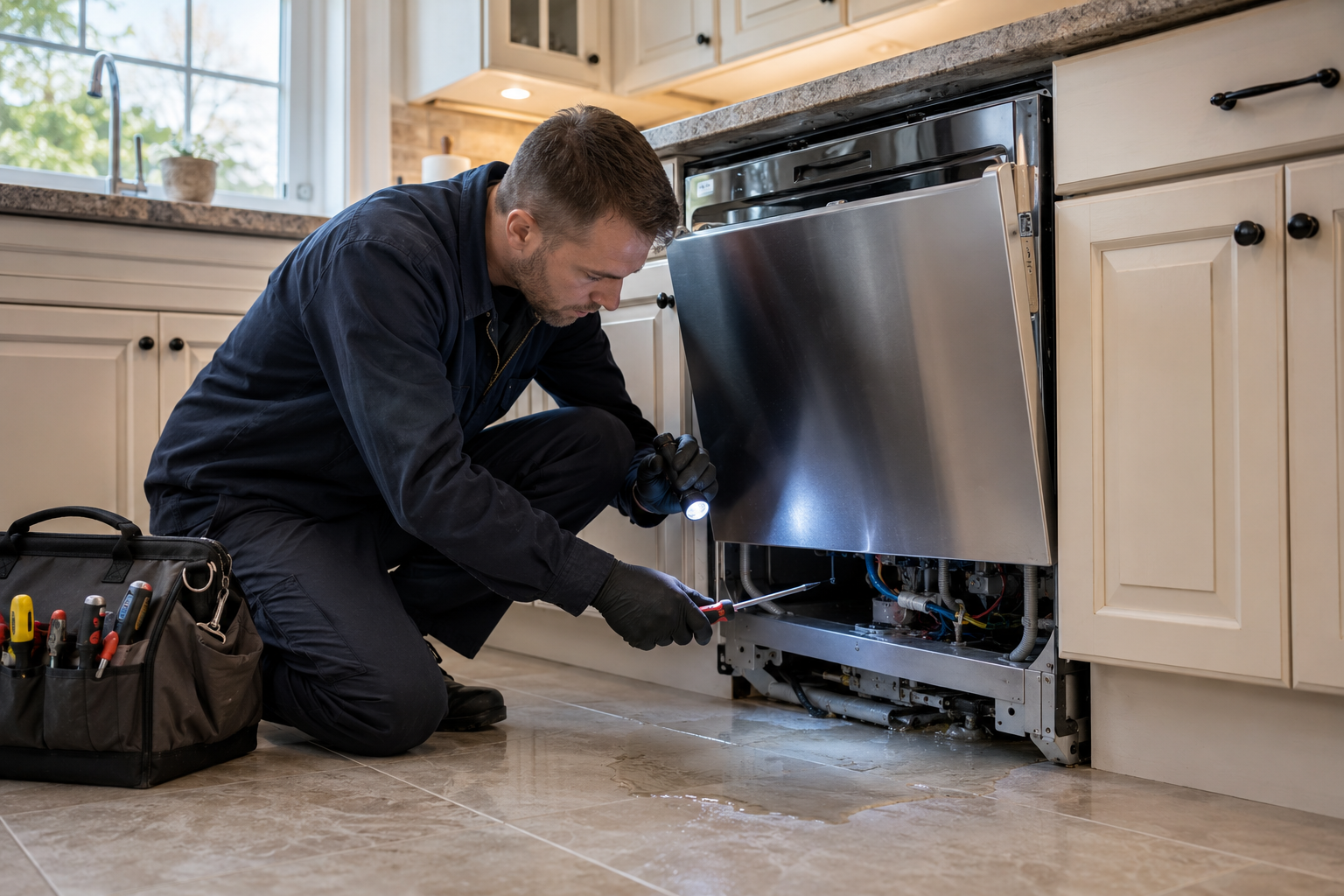
Insert one photo of a technician inspecting an open dishwasher in a Portland kitchen. Alt text: “Dishwasher leaking repair diagnosis by a certified technician.”
