
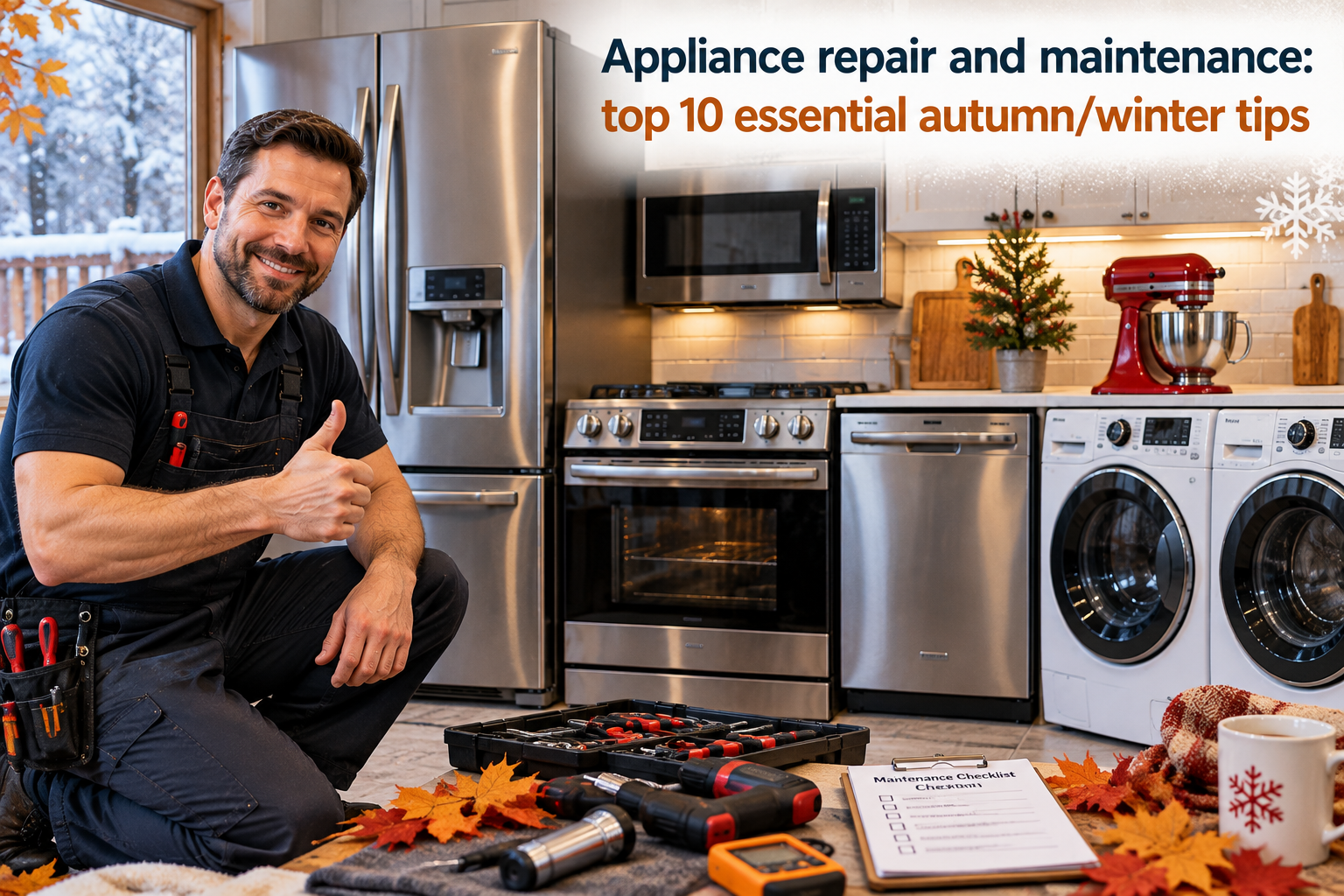
Appliance repair and maintenance: top 10 essential autumn/winter tips is the ideal time to proactively safeguard your home’s critical systems before cold weather and holiday demands strain them. As outdoor temperatures drop and indoor heating increases, appliances face new stressors—condensation buildup, thermal contraction of components, reduced airflow from closed windows, and heavier usage during meal prep and laundry cycles. Unlike reactive repairs after failure, preventive appliance repair and maintenance reduces unexpected breakdowns, extends equipment life, and supports energy efficiency when utility costs rise. Autumn offers a practical window: service technicians are more available than in December, HVAC systems aren’t yet running at peak load, and you can test fixes before holiday guests arrive or frozen pipes become an issue.
Appliance repair and maintenance: top 10 essential autumn/winter tips helps homeowners avoid seasonal surprises—from a refrigerator struggling with back-to-back holiday leftovers to a sump pump overwhelmed by early thaws and rain-snow mix. This list isn’t about generic cleaning checklists. It’s grounded in how temperature shifts, humidity changes, and usage patterns uniquely affect residential appliances between October and March. Each tip reflects real-world service observations from field technicians and aligns with manufacturer guidance from brands like Whirlpool, GE Appliances, and LG—as well as safety standards published by the U.S. Consumer Product Safety Commission (CPSC). Below are ten targeted, actionable steps—prioritized by risk, frequency of failure, and preventive impact.
Appliance repair and maintenance: why autumn is the ideal time for preventive service
Autumn bridges summer’s humidity and winter’s dry cold—a transitional period where ambient conditions allow safe, thorough inspection without emergency pressure. Technicians can access condenser coils, test defrost cycles under moderate loads, and verify thermostat calibration before extreme indoor/outdoor differentials skew readings. Waiting until November or December often means longer wait times, higher labor demand, and rushed diagnostics amid holiday scheduling constraints. According to the Appliance Service Association (ASA), over 68% of cold-weather appliance failures in residential settings stem from issues detectable—and correctable—during routine autumn service.
Preventive appliance repair and maintenance also avoids compounding problems. A slightly restricted dryer vent may function acceptably in August but becomes a fire hazard when combined with winter’s static-prone air and increased lint accumulation. Similarly, a minor refrigerant leak may not trigger immediate cooling loss in mild fall weather—but will accelerate under sustained holiday-use loads. Scheduling now ensures documented service history, which supports warranty claims and informs future decisions about repair versus replacement.
Prepare your refrigerator for colder months and holiday cooking demands
Refrigerators work harder in autumn—not because of outdoor cold, but due to increased door openings, bulk food storage, and warmer cooked items placed inside. Frost buildup, inconsistent temperatures, and compressor short-cycling often emerge only after Thanksgiving meals begin. Start by verifying that evaporator and condenser coils are clean and unobstructed. Dust and pet hair on coils reduce heat transfer efficiency, forcing the compressor to run longer and increasing wear. Use a soft brush or vacuum attachment—never compressed air or abrasive tools—to avoid damaging finned surfaces.
Next, inspect door gaskets for cracks, stiffness, or gaps. Cold air leakage is rarely audible, but a simple dollar-bill test reveals seal integrity: close the bill in the door and try to pull it out. If it slides free easily, the gasket needs cleaning or replacement. Also confirm that interior fans (in models with dual evaporators or freezer-on-bottom designs) operate smoothly—frozen or obstructed fans cause uneven cooling and frost accumulation in the fresh-food compartment. For guidance on identifying and replacing common gasket types, see our refrigerator door seal troubleshooting guide.
Winterize your washing machine to prevent freezing and moisture-related failures
Washing machines in unheated garages, basements, or utility rooms are vulnerable to freezing when ambient temperatures dip below 40°F (4°C). Frozen water in inlet valves, drain pumps, or internal hoses can crack housings or rupture solenoids—leading to leaks or complete failure upon thawing. Before first frost, disconnect and drain all water lines. Run a hot-water cycle with no load to flush residual moisture from the tub and pump. Then leave the door or lid open slightly to promote air circulation and prevent mold growth in damp rubber bellows.
Also inspect the machine’s leveling. Uneven placement stresses suspension components and contributes to excessive vibration—especially problematic on cold, rigid concrete floors. Tighten adjustable feet and recheck with a bubble level. If your washer uses a drain hose that loops into a standpipe, ensure the loop height remains between 30–96 inches above the floor per AHAM Standard W100, preventing siphoning and backflow. For front-loaders, clean the detergent drawer and rubber door boot weekly through winter to inhibit mildew in low-humidity indoor air.
Check dryer ventilation before heavy laundry seasons begin
Clogged dryer vents are the leading cause of residential clothes dryer fires—accounting for an estimated 2,900 U.S. home fires annually, according to the U.S. Fire Administration. Autumn is the last reliable opportunity to inspect and clean the full exhaust path: from the lint trap housing, through flexible or rigid ducting, to the exterior vent hood. Lint accumulation worsens in winter due to drier indoor air, which increases static cling and fiber shedding.
Use a dryer vent brush kit to clear rigid metal ducts; avoid plastic or foil accordion-style ducts, which trap lint and restrict airflow. Confirm the exterior vent flap opens freely and isn’t blocked by snow, ice, or nesting debris. If your dryer takes significantly longer to dry loads—or shuts off mid-cycle—the vent system likely requires professional cleaning. Note: Never bypass or disable the dryer’s thermal fuse or high-limit thermostat. These safety devices exist for good reason and should only be replaced with OEM-spec parts after root-cause diagnosis.
Inspect dishwasher seals and heating elements as indoor humidity drops
Lower indoor relative humidity during heated winter months accelerates drying and cracking of rubber door gaskets and tub seals. A compromised seal allows steam and heat to escape, reducing cleaning effectiveness and potentially warping nearby cabinetry. Visually inspect the gasket for brittleness, tears, or embedded food debris. Clean gently with warm water and mild dish soap—avoid bleach or abrasive pads that degrade elastomers.
Also verify proper operation of the heating element and high-limit thermostat. Dishwashers rely on water heated to at least 140°F (60°C) for sanitization and effective drying. If dishes emerge wet or cloudy—even with rinse aid—the heating circuit may be degraded. Test continuity across the element terminals with a multimeter (power disconnected), or observe whether the element glows red during a heated dry cycle. If not, the issue may lie with the thermostat, control board, or wiring—not just the element itself. For step-by-step electrical safety guidance, refer to the National Fire Protection Association’s NFPA 70E standard on electrical safety in the workplace, which outlines safe practices applicable to homeowner-level diagnostics.
Service your oven and range ahead of holiday baking and roasting
Oven temperature inaccuracy worsens in winter due to thermal expansion of internal components and drafts near kitchen doors or windows. Preheating times increase, and uneven browning becomes more common—often misdiagnosed as “faulty” when calibration or sensor cleaning resolves it. Begin by cleaning the oven cavity thoroughly, especially around the temperature sensor (typically a thin metal rod near the rear wall). Grease or sugar residue insulates the sensor, causing false readings.
Next, verify accuracy using an independent oven thermometer placed on the center rack. Run the oven at 350°F for 20 minutes, then compare readings. A variance greater than ±15°F warrants calibration (if supported by model) or professional sensor evaluation. Also inspect surface burners for clogged ports—common after summer grilling season—and test igniters for consistent sparking. Gas ranges require annual inspection of gas line connections and venting per CSA Z21.1 standards. Electric coil elements should sit flush and make full contact with their receptacles; arcing or discoloration indicates replacement is needed.
Test sump pump and basement appliances before winter precipitation peaks
Sump pumps face heightened demand during late-fall rains, early thaws, and snowmelt—especially if groundwater tables rise or downspouts discharge near foundations. A failed pump during a January thaw can cause thousands in water damage. Manually test yours now: pour five gallons of water into the pit and confirm the pump activates, runs smoothly, and discharges outside (not into a sewer or frozen yard). Listen for grinding or humming—signs of impeller binding or motor failure.
Also inspect the discharge pipe for cracks, loose couplings, or ice-prone routing. Ensure the vent hole (if present) is clear and the float switch moves freely without obstruction. Replace backup battery systems every 2–3 years, and consider installing a water alarm for early leak detection. For homes with dehumidifiers in basements, clean the condensate pump reservoir and replace filters—cold air holds less moisture, but condensation still forms on cold walls and pipes, feeding mold growth in enclosed spaces.
Review HVAC-linked appliances like heat-pump dryers and smart thermostats
Heat-pump dryers rely on ambient air temperature to operate efficiently—typically requiring minimum room temps above 45°F (7°C). In unheated laundry rooms or garages, performance plummets, and defrost cycles may fail to clear ice from evaporator coils. Relocate the unit if possible, or ensure the space stays above its operational threshold. Likewise, smart thermostats linked to HVAC systems influence whole-home humidity and airflow—both of which indirectly affect appliance longevity. Low humidity dries out rubber seals; excessive cycling strains compressors.
Verify that your thermostat’s humidity sensor is calibrated and located away from heat sources or direct sunlight. If using a connected humidifier, clean its reservoir and replace filters monthly to prevent microbial growth. Also review firmware updates for both thermostat and heat-pump dryer—manufacturers regularly release patches addressing cold-weather operational bugs. For authoritative guidance on residential HVAC integration, consult the Air-Conditioning, Heating, and Refrigeration Institute (AHRI) guidelines.
Maintain garage-based appliances exposed to temperature swings and condensation
Garage-mounted freezers, refrigerators, and water heaters endure dramatic daily temperature fluctuations—often ranging from 20°F to 85°F within 24 hours. These swings cause condensation inside control panels, corrosion on electrical contacts, and premature fatigue in insulation and gaskets. Inspect all units for signs of moisture: fogged display panels, white powdery corrosion on terminals, or musty odors indicating mold behind panels.
Ensure freezers and refrigerators rated for “garage use” are installed—standard models lack the necessary compressor and thermostat design for sub-50°F environments. If your unit isn’t garage-rated, consider relocating it or adding supplemental insulation around the cabinet (not over vents or condenser coils). For water heaters, flush the tank to remove sediment that accelerates corrosion in cooler operating conditions—and check the anode rod for depletion, replacing it if more than 6 inches of core wire is exposed.
Schedule professional appliance repair and maintenance before holiday scheduling fills up
Technician availability tightens rapidly after Thanksgiving. Most local service providers report 3–5 business day wait times by early December—and emergency rates often apply for holiday-week calls. Booking autumn maintenance secures priority scheduling, access to genuine parts inventory, and time for comprehensive diagnostics—not just symptom suppression. A qualified technician will perform load testing, electrical safety checks, refrigerant verification (where applicable), and airflow measurements—not just visual inspections.
Importantly, professional appliance repair and maintenance includes documentation: service dates, parts replaced, and baseline performance metrics. This record supports warranty validation and informs long-term reliability planning. If your appliance is older than 10 years, ask for a written assessment of remaining service life versus replacement cost—especially for units with known obsolescence risks (e.g., discontinued control boards or sealed-system components). For help identifying reputable local providers, the Better Business Bureau (BBB) offers verified service listings and complaint histories.
Appliance repair and maintenance: top 10 essential autumn/winter tips delivers measurable value—not just convenience. It’s about avoiding avoidable failures, conserving energy, protecting your home, and ensuring your appliances support—not hinder—your seasonal routines. Each action outlined here reflects field-tested priorities, not theoretical best practices. By acting now, you turn seasonal preparation into lasting resilience. And remember: while many tasks are DIY-accessible, refrigerant handling, electrical component replacement, and gas-line verification require licensed professionals—always prioritize safety over speed. For more seasonal guidance, explore our comprehensive home appliance maintenance calendar.
