
IMPORTANT SAFETY NOTICE: This article is an informational bulletin only. It is not a repair instruction, guide, or directive, and nothing here tells you to perform any work. Any action you choose to take is entirely at your own risk. Smooth Appliance Services LLC assumes no liability for personal injury, death, or property damage resulting from actions taken by the reader. For any repair or safety concern, contact a licensed professional technician.
Recognizing the warning signs of an Oven Not Heating early helps you communicate clearly with a technician and avoid unnecessary service calls.
Table of Contents
- Power Supply: Signs of Interruption
- Control Settings: Common Misconfigurations
- Door Latch: Symptoms of Engagement Failure
- Bake Element: External Signs of Damage
- Gas Igniter: Warning Signs in Gas Ovens
When your oven fails to heat, it disrupts meal prep, baking schedules, and daily routines. If your Oven Not Heating issue persists beyond a simple setting error, recognizing the external warning signs early helps you communicate clearly with a technician. Since 2017, Smooth Appliance Services has helped Portland-area families diagnose oven problems safely. This article outlines the five most common symptom categories homeowners can observe externally—without opening panels, touching wiring, or handling gas components.
Power Supply: Signs of Interruption
Oven Not Heating can stem from a simple power delivery issue. External symptoms include a completely unresponsive control panel, no display lights, and no audible sounds when buttons are pressed. You may also notice other appliances on the same circuit behaving abnormally.
In some cases, the oven display works but heating does not engage, suggesting the issue lies downstream of power delivery—such as a failed element or sensor. These components require professional diagnosis with specialized tools.
For built-in or wall ovens on dedicated 240-volt circuits, visual confirmation of power is often impossible without removing panels. Any suspected electrical fault should be handled by a licensed technician. Attempting to test voltage or reset breakers repeatedly risks further damage and personal injury.
Control Settings: Common Misconfigurations
A surprisingly common cause of no heat is incorrect control input. Modern ovens offer multiple modes—Bake, Broil, Convection Bake, Proof, Keep Warm—and only certain ones activate the primary heating element.
External symptoms of misconfigured settings include the display showing “Preheating” without generating heat, a control lock icon (often a padlock or “LOC” message) on the screen, or the clock engaged in delay-start mode. The oven may appear functional but won’t respond to immediate commands.
Some models default to “Off” after a self-clean cycle or power interruption and require manual reselection. If settings appear correct and the display shows the target temperature but no heat occurs, the command isn’t reaching the heating element—pointing to wiring or control board issues requiring professional assessment.
Door Latch: Symptoms of Engagement Failure
Self-cleaning ovens incorporate a mechanical or electronic door latch linked to a safety switch. This switch prevents operation unless the door is fully closed and verified as secure, protecting against fire and carbon monoxide risks during high-temperature cycles.
External symptoms of latch failure include the oven refusing to start despite correct settings, error codes like “F90,” “E1,” or “DOOR” on the display, or the door feeling loose, sticky, or misaligned. You may notice debris, warping, or broken plastic components near the door frame or hinge area.
Never force, wedge, or bypass the safety switch. If the latch appears intact but the oven still won’t heat, the switch itself may have failed internally—a job for a certified technician. Oven Not Heating paired with latch error codes strongly suggests a safety-system fault that requires professional replacement.
Bake Element: External Signs of Damage
The bake element is the exposed metal coil at the bottom of electric oven cavities and serves as the primary heat source. When it fails, the oven may run but produce no heat, or heat unevenly.
External symptoms of bake element failure include visible blistering, sagging, separation, or dark burn marks on the coil when viewed through the open oven door. You may also notice the oven taking much longer to reach temperature or cycling on briefly before shutting off.
A cracked or melted element almost always requires replacement. Never touch the element while the oven is warm or powered, and never attempt continuity testing without proper training—exposed terminals retain dangerous voltage even after unplugging. A faulty bake element is a frequent cause of Oven Not Heating, and replacement by a certified technician ensures safe, lasting results.
Gas Igniter: Warning Signs in Gas Ovens
Gas ovens rely on both fuel delivery and ignition. The igniter—a small rectangular or round ceramic component near the burner tube—must glow bright orange within 30–90 seconds to open the gas safety valve and allow combustion.
External symptoms of igniter failure include the igniter glowing weakly (dull red) or not at all when Bake is selected, a clicking sound without flame ignition, or the smell of gas without successful lighting. If the igniter glows brightly but no flame appears after 90 seconds, the gas safety valve likely isn’t opening—a sign of component wear.
Never attempt to light a gas oven manually or tamper with gas lines, valves, or regulators. A gas odor—described as rotten eggs—means evacuate immediately and call your utility provider. All gas-related Oven Not Heating issues require certified technicians familiar with local codes and manufacturer specifications.
These five symptom categories cover the most frequent causes of Oven Not Heating. Monitoring them externally helps you communicate clearly with a technician and avoid unnecessary assumptions. When troubleshooting reveals uncertainty, or signs of electrical, gas, or internal-component concern—reach out to qualified professionals immediately. Smooth Appliance Services LLC provides same-day oven repair across Portland, Beaverton, Tigard, Gresham, Hillsboro, Lake Oswego, Milwaukie, and Oregon City, with certified, insured, and bonded technicians and a free service call with every completed repair. Call (971) 236-2052 or learn more about our professional appliance repair services. For safety guidance on household appliances, refer to the U.S. Consumer Product Safety Commission.
Image recommendation:
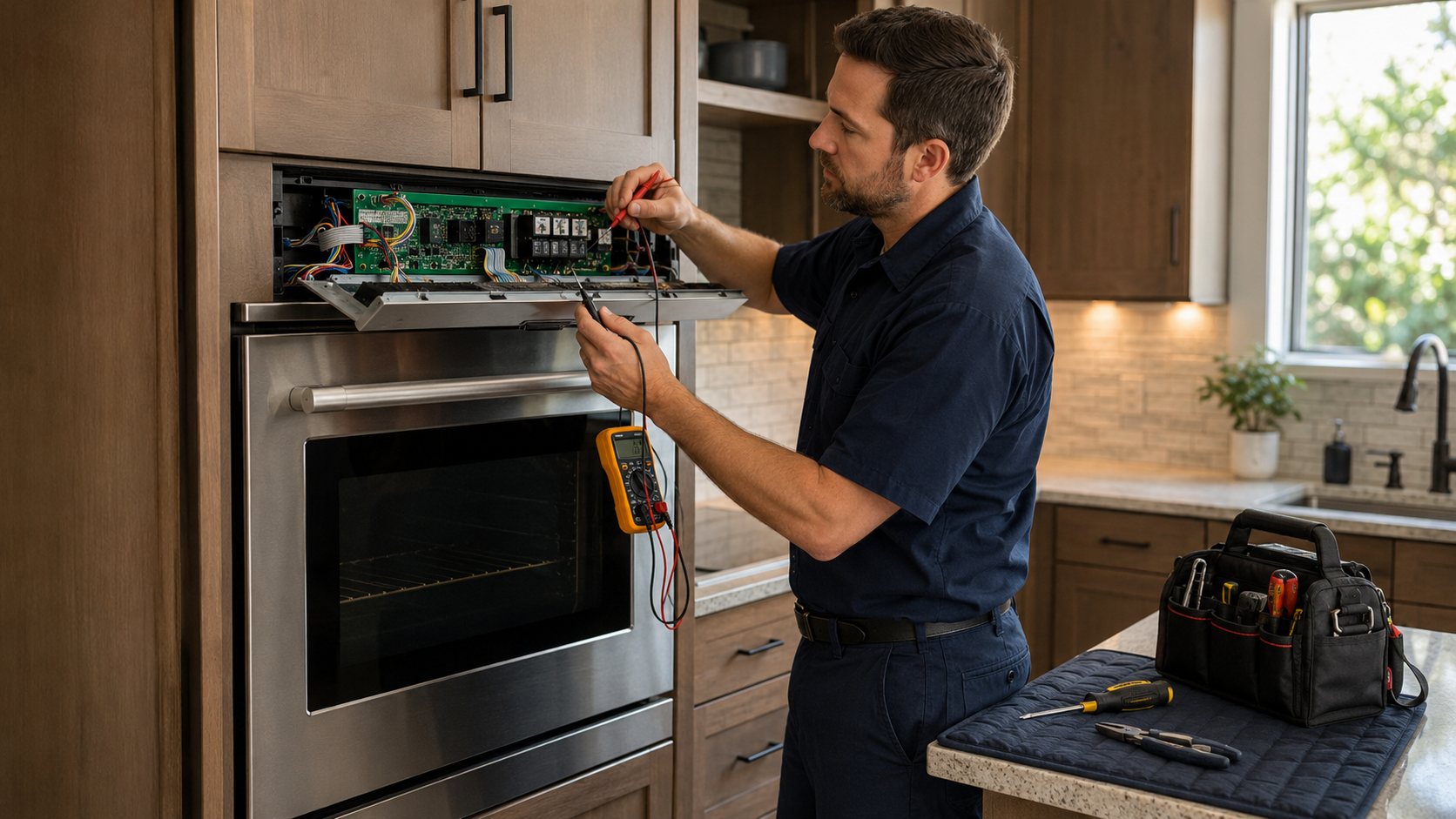
Use a photo of an open electric oven with a technician inspecting the bake element. Alt text: “Oven Not Heating diagnostic checklist by a certified technician.”
